
THE GENEROSITY OF CANADIANS: LESSONS FROM OPERATION SYRIAN REFUGEES
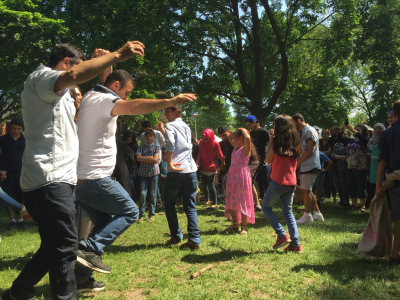 Syrian newcomers join in traditional dance at COSTI picnic.
Ten years ago, the first Syrian refugees stepped off military-chartered planes at Toronto’s Pearson Airport. They were greeted warmly and given winter coats to shield themselves from a cold Canadian night.
What followed would become one of the largest and fastest refugee resettlement operations in Canadian history, with 25,000 Syrian refugees brought to safety in just five months.
COSTI, the organization I led at the time, had been helping newcomers since 1952, but we still scrambled to find apartments for families who often arrived with nothing but the clothes on their backs. Large families, complex health needs, language and cultural differences added layers of complexity. One week we were told to expect 200 arrivals, the next week it was 600.
We adapted on the fly.
These hurdles were met with an outpouring of Canadian generosity unlike anything I have ever witnessed. Faith communities opened their doors, offering welcome dinners and essentials. Health professionals set up clinics and administered thousands of vaccines, and even dental care.
The generosity extended to landlords, who reserved apartments for refugee families, and employers, who offered jobs and training programs. The Canada Child Tax Benefit proved crucial in helping families afford housing, and the Toronto District and Catholic School Boards stepped up to integrate children into classrooms, giving them backpacks, lunches, and the gift of routine.
Volunteers flooded our operation with mountains of donated clothing, turning banquet halls into dignified “pop-up” shops where families could choose what they needed.
That generosity—expressed in a knitted scarf that was donated with a note reading, “I haven’t knit in 40 years, but you were a good reason to start”—is what made Operation Syrian Refugees not just a success, but a defining moment in our national story.
None of this would have happened without unprecedented cooperation. Federal, provincial, and municipal governments held weekly crisis calls to solve problems in real time. Funding rules were flexed, resources were mobilized, and red tape was cut.
Despite the overwhelming support, the operation was not without its hurdles. The accelerated pace of arrivals left little time for pre-departure orientation, leading to anxiety and misconceptions among the refugees. Cultural differences also presented challenges, from misunderstandings about Canadian customs to complaints about unfamiliar food.
Yet, the resilience of the refugees and the commitment of volunteers and service providers made the impossible possible. A refugee chef dissatisfied with Western food earned his food-handling certificate in record time and began cooking traditional meals for hundreds of his fellow newcomers. Today, he owns a thriving restaurant in Mississauga.
In May 2016, as my team and I celebrated the last Syrian family moving out of temporary accommodations into a permanent home, one of my staff turned to me with tears in her eyes and declared the experience one of the most rewarding in her life. That sentiment simply captured the intensity and profound pride of those extraordinary months.
Canada repeated this extraordinary effort in 2021 with Afghan refugees and in 2022 with a special program for Ukrainian newcomers. The impact of these initiatives on the lives of the refugees has been profound as it has provided them with a sense of personal security and a life of possibility for them and their children.
As we mark the anniversary of those first planes touching down on December 10, 2015, it is worth remembering what Canada is capable of when government, institutions, and ordinary residents align around a shared moral purpose.
One refugee said it best: “The generosity of Canadians impressed us most.”
That generosity did not just resettle people—it rebuilt lives, strengthened communities, and reminded the world what compassion in action looks like.
Now, in 2025, in a world fraught with conflict, where Canadians are suffering economically, it is more important than ever to find a way to continue demonstrating those values. It has been said that “there is no us and them: it is an illusion. We are all human beings.” When we forget, we lose everything.
Mario Calla is the President of the Board of Directors at COSTI. He previously led COSTI for 35 years and received numerous awards for his work with newcomers, including personally sponsoring five refugee families with his wife.